Toronto MRI Wait Times in 2026: What GTA Patients Need to Know
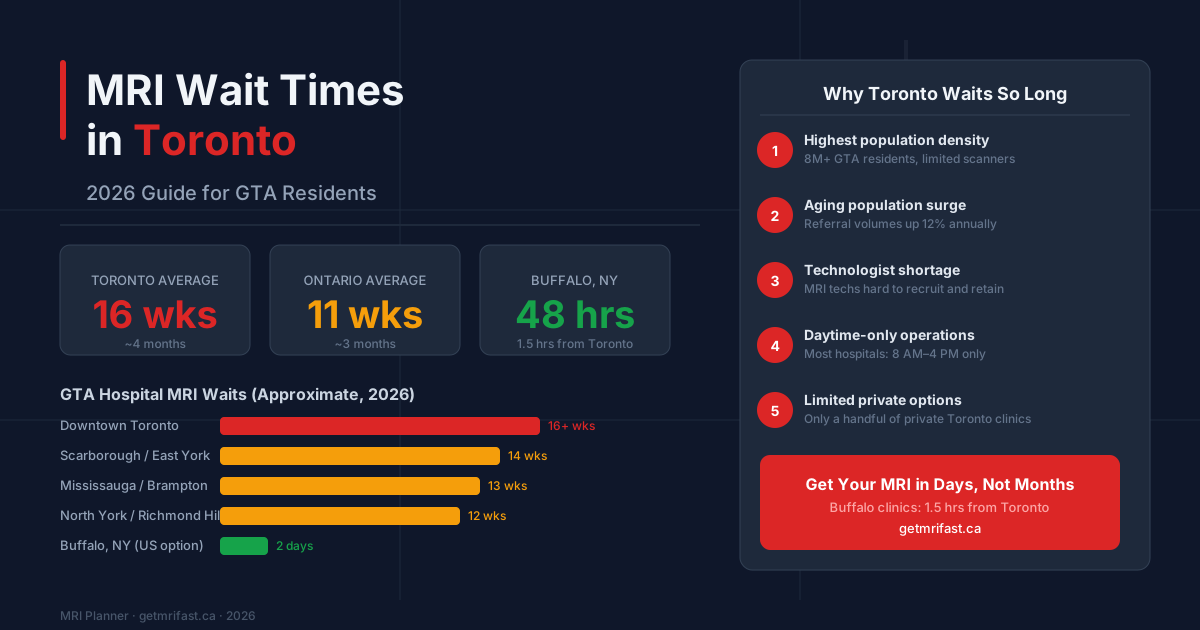
If you live in the Greater Toronto Area and your doctor has ordered an MRI, you are facing one of the longest diagnostic imaging queues in the country. While Ontario's provincial average is roughly 11 weeks, patients in the densely populated GTA—particularly in downtown Toronto—regularly wait 14 to 16 weeks or more for a non-emergency scan. That is nearly four months of uncertainty while living with pain, undiagnosed conditions, or mounting anxiety about your health.
This guide focuses specifically on what Toronto and GTA patients need to know: where the waits are longest, what private MRI options exist in the city, and how to legally bypass the queue entirely if you need answers sooner.
How Long Is the MRI Wait in Toronto Right Now?
The honest answer is that exact wait times vary by hospital, requisition priority, and the body part being scanned—but the general picture for Toronto patients in 2026 is discouraging.
According to data compiled by the Canadian Institute for Health Information (CIHI) and the Fraser Institute's annual wait times report, non-urgent MRI wait times in Ontario consistently exceed the province's own 28-day target. In the GTA, where the majority of Ontario's population is concentrated, waits routinely run two to four times that target.
What patients typically experience:
These are median estimates. Individual results depend on which hospital is accepting your referral, how your requisition is triaged, and whether you are placed on a cancellation list.
Why Toronto Waits Are Longer Than the Ontario Average
The province-by-province MRI wait time breakdown shows Ontario as the worst province in Canada for diagnostic imaging delays. Within Ontario, the GTA concentrates the problem further. Here is why:
MRI Wait Times Across the GTA: Hospital by Hospital
While the Ontario Wait Time Information System provides some facility-level data, actual wait times are not always published transparently. The estimates below reflect general patterns reported by patients and health system observers:
Downtown Toronto
Hospitals in the core—including Toronto General Hospital (UHN), Toronto Western Hospital, and St. Michael's Hospital—are among the busiest imaging departments in the country. Non-urgent MRI waits of 14 to 18+ weeks are common, driven by high case complexity and referral volumes from specialists across the province.
Scarborough and East Toronto
Scarborough Health Network's multiple campuses serve one of the GTA's fastest-growing and most densely populated areas. Non-urgent waits are typically 12 to 15 weeks—somewhat shorter than downtown facilities but still well above the province's 28-day target.
North York and York Region
North York General Hospital and Humber River Hospital (in the North York area) report waits in the range of 11 to 14 weeks for routine scans. York Region facilities (Markham Stouffville, Mackenzie Health in Richmond Hill) are slightly less congested but still post waits of 10 to 13 weeks.
Mississauga and Brampton
Trillium Health Partners (Credit Valley and Mississauga hospitals) and William Osler Health System (Brampton Civic, Etobicoke General) serve the western GTA. Non-urgent MRI waits here tend to be 11 to 14 weeks, comparable to the provincial average but still far above the target.
Etobicoke and West Toronto
Etobicoke General (part of William Osler) and St. Joseph's Health Centre handle significant west-end volumes. Waits are typically 12 to 15 weeks for non-urgent referrals.
The takeaway: regardless of which GTA hospital is on your requisition, you should plan for a minimum of 12 weeks—and potentially much longer—if you are waiting in the public system.
Private MRI Options in Toronto
Unlike British Columbia and Alberta, where private diagnostic imaging clinics are relatively common, Ontario has historically restricted private MRI access. That said, a small number of facilities in Toronto do offer private (self-pay) MRI services:
Medcan Health Management (150 York Street, downtown Toronto)
Medcan is Toronto's most well-known executive health clinic. They offer private MRI as part of comprehensive health assessments. Private MRI at Medcan is typically available within 1 to 2 weeks of booking, making it substantially faster than the public system.
Typical costs at Medcan: $900 to $1,400 CAD depending on the body part and whether contrast is required. Brain MRI tends to be at the higher end; musculoskeletal scans (knee, shoulder) at the lower end. Note that Medcan is a premium offering—expect corresponding service levels and pricing.
Cleveland Clinic Canada (181 Bay Street, downtown Toronto)
Cleveland Clinic Canada brings the US health system's private model to Toronto. They offer private diagnostic imaging including MRI, with appointments typically available within 1 to 3 weeks. Their MRI services use modern 3 Tesla equipment.
Typical costs at Cleveland Clinic Canada: $950 to $1,300 CAD per scan. Contact them directly for current pricing as rates vary by scan type and clinical needs.
What Private MRI Costs in Toronto
Here is a summary of approximate private MRI pricing in Toronto vs cross-border alternatives:
Private MRI in Toronto (CAD):
Cross-border MRI in Buffalo, NY (USD):
At current exchange rates, Buffalo pricing is often 30 to 50 percent less expensive than Toronto private clinics—and Buffalo clinics can typically book within 24 to 48 hours rather than 1 to 3 weeks. See our full private MRI cost comparison: Canada vs the United States for detailed pricing data.
5 Ways GTA Patients Can Get an MRI Faster
If you cannot wait 3 to 4 months for your scan, here are the most effective options available to Toronto and GTA patients:
1. Book at a US Cross-Border Clinic (Most Effective)
The single most effective way to skip the GTA MRI queue is to book at a US clinic. For Toronto patients, Buffalo, New York is the primary option—approximately 1.5 hours from downtown Toronto via the QEW and Peace Bridge border crossing.
Buffalo clinics routinely offer appointments within 24 to 48 hours. Results are returned digitally, typically within one business day, and can be shared directly with your Canadian physician. Our complete guide to Buffalo MRI clinics for Canadians covers the top facilities, pricing, and what to expect at the border.
2. Ask Your Doctor to Place You on the Cancellation List
Every hospital MRI department maintains a cancellation list. When a scheduled patient cancels (which happens regularly), the booking office calls the next person on the list. Provide multiple phone numbers and make clear you can arrive with short notice—sometimes that means same-day availability.
3. Request a Referral Outside the GTA
If your condition does not require a specific specialist at a downtown hospital, ask your doctor to consider facilities with shorter waits—hospitals in smaller Ontario cities like Barrie, Guelph, Kingston, or Peterborough sometimes have fewer referrals in the queue. This can shave 2 to 5 weeks off your wait without leaving Ontario.
4. Book at a Toronto Private Clinic
If your condition requires a Canadian report (for insurance, WSIB, or legal purposes), Toronto's private clinics like Medcan or Cleveland Clinic Canada can get you scanned in 1 to 3 weeks. Expect to pay $750 to $1,400 CAD out of pocket. Check whether your employer's extended health plan covers private MRI before booking.
5. Use MRI Planner to Compare Options
MRI Planner aggregates US clinic availability near the Canada-US border. For Toronto patients, you can see real-time availability at Buffalo-area clinics, compare pricing, and book an appointment online. Most patients go from booking to receiving results within one week. See our full guide to 7 proven strategies for getting your MRI faster in Canada.
The Buffalo Option: 90 Minutes from Toronto
Buffalo has become the most popular cross-border MRI destination for GTA residents, and for good reason. Multiple imaging clinics in the Buffalo-Niagara region actively market to Canadian patients, offer same-week appointments, and provide competitive transparent pricing.
Getting There from Toronto
Recommended route (QEW westbound to Peace Bridge):
Alternative route (Queenston-Lewiston Bridge):
What to bring at the border:
Same-Week Appointments at Buffalo Clinics
Canmax Medical Imaging in Buffalo is the most well-known clinic serving Canadian patients, actively advertising to Ontario residents. Several other imaging centres in the Buffalo area—including DENT Neurologic Institute and independent radiology groups—also welcome self-pay Canadian patients. Pricing is typically posted transparently and payment is made at time of service.
For a full breakdown of Buffalo-area clinics, what they charge, and how to book, see our Buffalo MRI clinics for Canadians guide. And if you have questions about what to bring, insurance considerations, and day-of logistics, our complete cross-border medical imaging guide covers everything you need to know.
Frequently Asked Questions for Toronto MRI Patients
How long do you wait for an MRI in Toronto in 2026?
Non-urgent MRI wait times in Toronto average 12 to 16 weeks (3 to 4 months) as of 2026. Wait times depend on the hospital, body part, and how the requisition is triaged. Downtown Toronto hospitals and those serving large specialist populations tend to have the longest waits in the GTA.
Can I pay for a private MRI in Toronto?
Yes, but options are limited compared to other provinces. Medcan (150 York Street) and Cleveland Clinic Canada (181 Bay Street) both offer private MRI services in downtown Toronto. Appointments can typically be booked within 1 to 3 weeks. Expect to pay $750 to $1,400 CAD depending on the scan type. Ontario regulations restrict widespread private MRI, so there are far fewer private options here than in Alberta or BC.
How much does a private MRI cost in Toronto?
Private MRI in Toronto ranges from approximately $750 to $1,400 CAD per scan. Brain and abdominal MRI are at the higher end; knee and shoulder scans are generally less expensive. By comparison, cross-border MRI in Buffalo typically costs $400 to $800 USD—often less expensive even after the exchange rate, and available within 24 to 48 hours.
Is it faster to get an MRI in Buffalo from Toronto?
Yes, significantly faster. Toronto public wait times average 12 to 16 weeks; Buffalo clinics typically book within 24 to 48 hours. The drive from downtown Toronto to Peace Bridge is approximately 90 minutes. You will need your Canadian doctor's referral and a valid passport. Most patients can complete the trip—drive, scan, and drive back—in a single day.
Does OHIP cover cross-border MRI?
Generally, no. OHIP does not routinely cover elective MRI scans performed in the United States. However, Ontario's Health Insurance Act does allow reimbursement for out-of-province emergency care in some circumstances. If you are traveling to Buffalo specifically for an MRI, plan to pay out of pocket and keep all receipts. Some employers' extended health benefits plans cover diagnostic imaging outside Canada—check your policy details.
What should I do after getting my MRI in Buffalo?
Your Buffalo clinic will provide you with digital images (typically on a CD or download link) and a radiologist report. Share both with your Canadian doctor as soon as possible. Your physician can interpret the results and guide next steps in your care, including any follow-up within the Ontario health system. The report from a US-licensed radiologist is medically valid and accepted by Canadian physicians and specialists.
Take Control of Your MRI Timeline
Toronto's MRI wait time crisis is a systemic problem that will not be solved quickly. But as a patient, you have options—whether that means finding a private clinic in the city, getting on a cancellation list at your local hospital, or making the 90-minute drive to Buffalo for a next-day appointment.
MRI Planner is designed to help GTA residents navigate these choices. Browse available appointments at US clinics near the Peace Bridge, compare pricing, and book online in minutes. You should not have to wait four months for answers about your health.
See how quickly you could get your MRI. Explore available appointments and take the first step toward faster answers.
Found this helpful?
Share this article