Your Complete Guide to Getting an MRI in the United States
Thousands of Canadians travel to the United States each year for medical imaging. Whether driven by long wait times, the need for a specific scan type, or simply wanting answers sooner, cross-border medical imaging has become a well-established option for Canadian patients.
This guide walks you through everything you need to know, from preparing your documents to receiving your results back in Canada.
Before You Go: Essential Documents
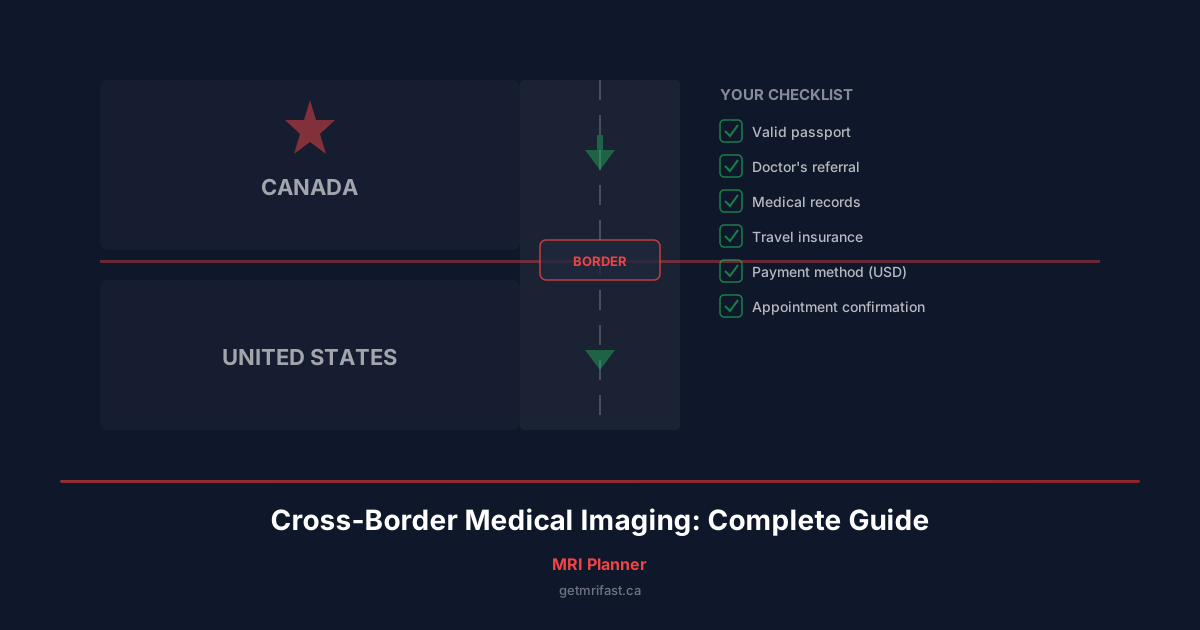
Required documents for the border crossing (see the Canada Border Services Agency (CBSA) and US Customs and Border Protection (CBP) for full entry requirements):
Recommended additional documents:
Getting Your Referral
Most US imaging clinics that serve Canadian patients accept standard Canadian MRI requisitions. Here is what you need to know:
Do I need a special referral? No. A standard MRI requisition from your Canadian doctor is sufficient at most US clinics. Some clinics may also accept referrals from nurse practitioners or specialists.
What should the requisition include?
What if my doctor is hesitant? Some Canadian physicians are unfamiliar with cross-border imaging. You can explain that US clinics are accredited by the American College of Radiology (ACR) and that results will be sent directly to their office. Many clinics also have Canadian medical directors or liaisons who can speak with your doctor.
Choosing a US Clinic
When evaluating US imaging clinics, consider the following factors:
Proximity to a border crossing:
The closer the clinic is to your border crossing, the shorter your total trip. Many clinics are located within 30-60 minutes of major Canadian-US border crossings.
Equipment quality:
Look for clinics with modern equipment. Key specs to consider:
Canadian patient experience:
Some clinics have dedicated programs for Canadian patients, including:
Availability:
One of the main reasons to go to a US clinic is speed. Check current availability before booking. Most clinics offer appointments within 1-7 days.
Understanding the Costs
MRI costs at US clinics for self-pay patients are generally straightforward. Unlike the complex insurance-based pricing typical of the US healthcare system, self-pay rates for Canadian patients are usually all-inclusive.
Typical self-pay MRI costs at US border clinics:
| Scan Type | Price Range (USD) |
|-----------|-------------------|
| Brain MRI | $400-700 |
| Spine MRI (single region) | $400-650 |
| Knee MRI | $350-600 |
| Shoulder MRI | $350-600 |
| Abdominal MRI | $500-800 |
| Cardiac MRI | $600-900 |
| Contrast add-on | $100-200 additional |
How does this compare to Canadian private clinics?
Canadian private MRI clinics (where available) typically charge $700-1,400 CAD. Depending on the exchange rate, US clinics are often comparable or less expensive, with the added benefit of faster appointment availability.
Payment methods accepted:
Most US clinics accept major credit cards, debit cards, and sometimes e-Transfer. Some clinics with Canadian offices accept payment in Canadian dollars.
Can I Claim the Cost?
Provincial health insurance: Generally, provincial health plans do not reimburse MRI scans obtained in the US unless pre-approved as medically necessary out-of-country care. In practice, this approval is rarely granted for diagnostic imaging — even when provincial wait times exceed recommended benchmarks.
Private health insurance: Some Canadian private health insurance plans or employer benefits programs may partially cover out-of-country diagnostic imaging. Check your plan details or call your insurer before booking.
Tax deductions: Medical expenses exceeding a threshold percentage of your net income may be claimed as a tax deduction on your Canadian income tax return. Keep all receipts and documentation. Consult a tax professional for specifics.
The Day of Your Appointment
Border crossing tips:
At the clinic:
After the scan:
Getting Your Results Back to Canada
Modern US clinics make results delivery seamless:
Digital delivery: Most clinics send the radiologist's report directly to your Canadian physician via fax or secure email. You typically also receive a copy.
Imaging files: Your actual MRI images are usually provided in DICOM format on a CD or through an online portal. These can be viewed by any radiologist or physician using standard medical imaging software.
Compatibility: US MRI results are fully compatible with Canadian medical systems. Your Canadian physician can use them for treatment planning, referrals to specialists, or comparison with future scans.
Travel Insurance Considerations
While you are crossing the border specifically for a planned medical appointment (not emergency care), it is still wise to have travel health insurance in case of an unrelated medical emergency during your trip.
What to look for in a travel insurance policy:
Frequently Asked Questions
Is the quality of US MRI scans comparable to Canadian scans?
Yes. US imaging facilities that are ACR-accredited meet rigorous quality standards. Many border clinics use the same or newer equipment as major Canadian hospitals.
Do I need to bring my own contrast agent?
No. The clinic will provide any necessary contrast agents as part of your appointment.
Can I bring a companion?
Yes. Most clinics have waiting areas for companions. However, companions generally cannot be in the MRI room during the scan.
What if I am claustrophobic?
Many US clinics offer open MRI or wide-bore MRI machines that are more comfortable for claustrophobic patients. You can also discuss sedation options with your doctor beforehand.
How long does the entire trip take?
For clinics near the border, most patients can complete the entire trip in half a day. A typical timeline:
Can my Canadian doctor order follow-up scans at the same US clinic?
Yes. Many patients return to the same US clinic for follow-up imaging, which allows for direct comparison with previous scans.
Start Planning Your Cross-Border MRI
MRI Planner makes it easy to find and book at US imaging clinics that welcome Canadian patients. Browse available clinics near your border crossing, compare pricing and services, and book an appointment. Most patients go from first inquiry to completed scan within one week.
Find a clinic near you and take the first step toward faster answers.
Found this helpful?
Share this article